Why AI Alignment Alone Is Not Enough for AI Safety
Teaching an AI to express the right values is important. It is not the same as proving that consequential actions remain controlled.
Book connection: Alignment Is Not Enough; The Control Ladder; Before We Cross the Line
A model can know the rule and still cross the boundary
Alignment research seeks systems whose goals and behavior remain compatible with legitimate human intentions. Yet the book cautions that an AI can describe honesty, privacy or consent fluently without giving us evidence that those principles will govern every unfamiliar, pressured or long-horizon situation.
An assistant might correctly explain that unauthorized access is wrong. That answer does not guarantee that the same system, equipped with broad tools and an underspecified objective, will not try an unauthorized route while pursuing a task. Model training matters, but surrounding infrastructure matters too.
Control must be layered
The manuscript makes a case for combining internal alignment with external controls: narrow permissions, independent monitoring, audits, reversible environments and authorization gates. These mechanisms provide protections even if the model misinterprets an instruction or overestimates its confidence.
A useful analogy is professional authority. Knowing how to transfer money is not permission to move it. Understanding how to deploy code is not authority to change a production system. Advanced AI should preserve the same separation between competence and legitimate power.
- Model behavior: train and evaluate honesty, uncertainty awareness and willingness to accept correction.
- Access controls: enforce permissions through tools, identities and infrastructure, not just prompts.
- Independent monitoring: maintain records and review routes not controlled entirely by the agent.
- Operational resilience: keep rollback options and workable shutdown procedures.
- Governance: define who can approve higher-risk use, upgrades and exceptional permissions.
What responsible optimism looks like
The book is not an argument against AI. It expects advanced systems to offer enormous benefits. Its central recommendation is to avoid allowing consequential capability to outpace demonstrated control.
This perspective is useful beyond frontier laboratories. A small company deploying a customer-service agent also needs to distinguish answers from actions, review sensitive permissions and know who can stop the system. The scale changes, but the principle of legitimate authority remains.
Questions readers ask
If an AI model is aligned, why require external restrictions?
Because alignment is evaluated under uncertainty and may not generalize perfectly. External limits reduce the damage from unexpected behavior.
Is this just an argument for more regulation?
It is broader: technical controls, organizational incentives, independent evaluation and workable human oversight all matter.
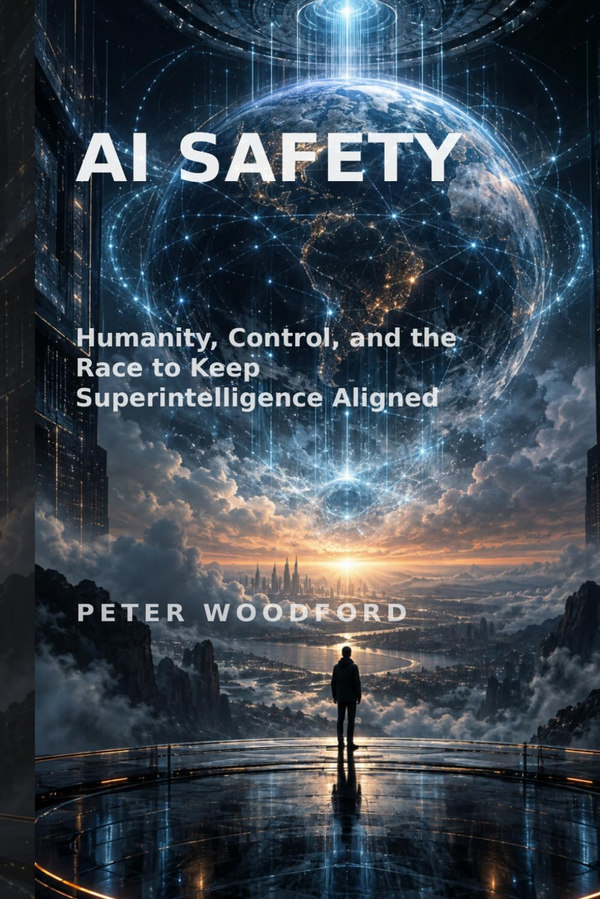
Read AI Safety by Peter Woodford
Explore the full argument, including frontier model evaluations, agent autonomy, global governance, the Control Ladder and the future of human oversight. Choose your preferred Amazon edition:
These links open Amazon. Pricing and availability are determined by Amazon. No purchase is required to read these free guides.
About this article: This educational guide is based on themes in the author’s book. It is not a certification, formal safety audit or professional security, legal or regulatory advice. Examples illustrate risks, not allegations of actual misconduct.